Chapter 1. 1505 – The Portuguese.

The Portuguese who took possession of the Maritime Provinces of Ceylon in 1505 obtained enormous financial benefits from the spices of Ceylon that they traded in Europe and after 150 years left behind an Eurasian race of Portuguese speaking people who would become known as Portuguese Burghers. 

In 1500, there were three kingdoms in Ceylon, Vira Parakrama Bahu (1484-1509) was the King of Kotte in the South-west, Senasammata Vikrama Bahu (1469-1511) was King in the Hill Country and Pararajasekeran (1469-1511) was the King of the Tamil Kingdom in the North-East.
Portugese Caravel

In 1505, ships of the fleet of the first Portuguese to visit Ceylon, with Dom Lourenco de Almeida were accidentally blown into the Port of Galle. In the last months of that year Dom Lourenco’s fleet anchored off Colombo and a memorial of this first landing called a “Padrao” with a cross above the Royal Arms of Portugal surmounting it, was erected on a boulder overlooking the Bay of Colombo. They entered into a treaty with the King of Kotte and built a factory to process cinnamon that was in abundant supply. In 1518, the Viceroy Lopo Soares de Albergaria landed at Colombo with a large fleet and began building a small triangular fort named “Noosa Senhora das Virtudes” or “Santa Barbara”

Padrao in Colombo Harbour

In 1524 they dismantled it and kept an agent in the Island under the protection of the Sinhalese King of Kotte. They established royal Monopolies in Cinnamon, pepper and musk. Giving up Colombo was a mistake as the colony of Muslim merchants immediately attempted to win back their supremacy in the Kingdom of Kotte and to re-conquer the cinnamon trade. However, they were defeated by the Portuguese still present on the Island. The Mappillas (Malabar Muslims) who up to 1539 nourished a dynastic conflict in the Kingdoms of Sitawaka and Kotte, opposed the Portuguese until in 1538 at Vedelai, Martin Afonos de Sousa and in 1539, Miguel Ferreira at Negombo, defeated the Mappillas and took away their cinnamon trade.

Before the arrival of the Portuguese, the kings of Ceylon were facing a Muslim Arab invasion from the West and a Mogul invasion from the East. Ceylon was under the protection of China and Sinhalese kings were paying ‘Kappam’ just before the Portuguese came. The Portuguese presence was a blessing in disguise as they hunted down and wiped out the Muslim Arabs throughout the island and the Chinese parasitism on Ceylon came to a halt. With the encouragement of the King of Kotte, the missionaries began the work of converting the peoples of Ceylon to Christianity and churches were built in the fishing villages on the western coast. It was a time of almost constant warfare, especially against the Kandyan Kingdom which resisted strongly the Portuguese attempts to promote Roman Catholicism. The main export commodities also included cardamoms, sandalwood, arecanuts, ebony, elephants, ivory, pearls and small quantities of tobacco, silk and kapok.

St Don Bosco Church, Wattala

In 1544, the King of Jaffna massacred more than 600 Christians in the island of Mannar. However, in 1545, when the Portuguese threatened retaliation, the King of Jaffna submitted and paid tribute to the Portuguese. In October 1550, the Viceroy Afonso de Noroha arrived in Ceylon and sacked Sitawaka with 500 Portuguese soldiers who were stationed at Kotte. But the Viceroy lost a good opportunity of establishing the supremacy of Portugal over the entire Island by not stationing soldiers in the captured towns. The treaty was renewed with the King of Kotte and in 1551 the Portuguese assumed the role of Protector of the Kotte Kingdom.

In November 1554, Duarte de Eca with 500 soldiers built a new fortress in Colombo. In 1556, 70,000 people who lived in the communities of fishermen on the sea coast north and south of Colombo were converted to Christianity. The King of Kotte, Darmapala was re-christened as Dom Joao Perya Bandara and the Queen re-christened as Dona Catherina. Following the king’s example a few nobles adopted the Portuguese title of Dom (Sir), the Portuguese manners and language.

In 1560, Viceroy Dom Costantino de Braganca with 1,200 men conquered the town of Nallur, the Capital of the Kingdom of Jaffna and soon after proceeded to the island of Mannar where a fort was built. In July 1565, the Portuguese transferred their Court and Capital from Kotte to Colombo. The conversions to Christianity had alienated the majority of Sinhalese on the West coast who then surrounded the Portuguese at Colombo. In 1574, the Portuguese took the offensive and they plundered Negombo, Kalutara and Beruwela and drove out the Sinhalese garrisons at Nagalagama and Mapane and ravaged the districts of Weligama and Chilaw. In 1587, Raja Sinha, the King of Kandy and Sitawaka began a siege of Colombo. The fort was protected by fortifications with 12 bastions that the Sinhalese assaulted many times but always failed. In February 1588, they abandoned the siege and until the end of the seventeenth century the Portuguese were masters of the coast forts of Colombo, Galle, Kalutara and Negombo.

In 1591, Andre Furtado de Mendoca invaded Jaffna and set up a new king at Nallur. The Portuguese also attempted to occupy Kandy but were met with failure.

In 1597, the Portuguese began to fortify Galle. The same year, King Dom Joao Dharmapala died without heirs and in accordance with his Will his Kingdom was donated to the King of Portugal. Thus, King Philip of the then united Kingdoms of Spain and Portugal was proclaimed the King of Ceylon and the whole territory of the Kingdom of Kotte, only Kandy was still not under Portuguese rule.

The Portuguese then attempted to unify the island under their control. In 1603, Dom Jeronimo de Azevedo attempted to occupy the abandoned fort at Balane, the key to Kandy, however a few days later he was forced to withdraw and the fort was lost. In 1611, De Azevedo marched with 700 Portuguese and Lascarins to Kandy re-taking the Fort at Balane, where he left a garrison. He was also successful in taking Kandy, which he then proceeded to burn and the King of Kandy submitted himself to the Portuguese. Although not destroyed, the Kingdom of Kandy had been neutralized.

In 1621, the Tamil Patriarch and Pretender to the Throne Cankli Kumaran fought the Portuguese forces under the command of Felipe De Oliveriya and were defeated. The soldiers destroyed hundreds of Hindu temples and left the Tamil kingdom in ruins.

The Tamils thereby lost their Kingdom, their sovereignty, independence and homelands.

In 1624, the Portuguese occupied and fortified Trincomalee.

In 1630, Dom Constantino de Sa, under pressure from the Viceroy, began a march with a small Portuguese army of 400 Portuguese soldiers, 200 Portuguese Casados (married men of the army reserve) and about 4,400 Lascarins to attack the Capital of King Senarata at Badulla by crossing the jungles of Uva. They sacked and burnt the deserted town but on the return to Colombo, were attacked by the Sinhalese and nearly 4,000 Lascarins deserted the Portuguese and joined the enemy. For the Sinhalese this was a decisive victory from which only 130 men survived and surrendered. After this victory, King Senarat captured Saparagamuwa and set Colombo under siege, but after three months the Sinhalese army was forced to withdraw.

Ceylon during the Portuguese Period

Thereafter, the Portuguese occupation of the country that was to last 150 years under a military form of government where martial law chiefly prevailed was weakened and vulnerable to the Dutch forces.

The Portuguese were from the beginning (Alfonso de Albuquerque) the first to experiment a colonization based on colonies of Portuguese citizens “Casados”. Since the Portuguese women were few, mixed marriages were encouraged between the Portuguese and Asians. Albuquerque tried to create a new Portuguese nation in Asia to make up for the lack of people from Portugal. This method of settlement was extremely successful.

After a century of this colonization, in practically every outpost of the empire, there were colonies of mixed Portuguese, that spoke Portuguese, were Catholic and were better suited to the tropical climates that the European born Portuguese. Thanks to this strategy, the Portuguese succeeded in withstanding the siege of the Dutch in Ceylon for sixty years.

The Portuguese left a Eurasian community (Portuguese Burghers) with surnames like Perera, Silva, Pieris, de Mel, de Soysa, etc, the Roman Catholic religion, Music (Baila), dress, food and Titles such as Sinno, Dona, Don, etc and a Portuguese Creole language, a dialect of which until recently was spoken by people of mixed African decent who are descended from a Portuguese regiment of soldiers from Mozambique who settled in the village of Sellankandal near the town of Puttalam, sometime in the seventeenth century.

In the presentation below their descendants sing in the creole language.


An interesting presentation about the Kaffir community in modern Sri Lanka.

http://www.youtube.com/watch?v=BXvLYV9MZLI&feature=related

The Portuguese brought western culture into Ceylon. The Kandyan Kings were educated by the Portuguese teachers. The Kandyan Royal Court had Portuguese ministers as advisers. But King Rajasinghe II was not happy with the Portuguese. The Portuguese came to trade with Ceylonese, but because of the foolishness of the natives, the Portuguese became their masters. The trade commodities were bought at minimum prices and the Portuguese made a huge profit selling the spices at European markets.

In the presentation below a dance that has lasted over 500 years is enacted by the descendants of the Portuguese.

http://www.youtube.com/watch?v=qeu7mkSYKcA&feature=related

The Ceylonese were unhappy about losing their freedom and lands to the Portuguese and they were totally distressed at seeing the Government from Lisbon hijacking the country. A beautiful country and culture was being vandalized by the Portuguese and Catholicism and the Portuguese language was being forced down their throats. They wanted religious freedom and political freedom from Portugal. They wanted Holland, a powerful enemy of Portugal to come to their aid. Even though Denmark offered to help, the King of Kandy wanted the help of the Dutch as there was a Dutch-Portuguese War raging.

When the Dutch ships landed in Batticaloe and communicated with the King of Kandy for allied action against the Portuguese, King Rajasinghe II immediately seized the opportunity to remove the Portuguese out of Ceylon.

An extract from a document about Western Colonialism is reproduced below.

Western colonialism: Portuguese and Dutch

The Portuguese arrival in Ceylon was an accident, a rude quirk of destiny. In 1505, a Portuguese fleet under the command of Don Lourenco de Almedia, forced by winds and waves, was tossed into Galle, the harbor located on the southern coast of the island. He learned that the island was the famous land called Ceilao, and he sailed on to Colombo, the port in the Kotte kingdom. When the Portuguese arrived in Ceylon, Vira Parakrama Bahu (1484-1509) was the king of Kotte, Senasammata Vikrama Bahu (1469-1511) was the king of the Hill country and Pararajasekeran (1469-1511) was the king of the Tamil kingdom.

In the beginning, the Portuguese desire was for trade, chiefly in cinnamon, but it also wanted a foothold on the island as it was strategically located to control the sea routes of the Indian Ocean. Accordingly, they entered into a treaty in 1505 with Vira Parakrama Bahu under which they were assured of a supply of cinnamon and also permission to build a factory. In 1518, the treaty was renewed, which drew the Portuguese into the local political arena owing to the internal rivalries and quarrels of the Sinhalese princes. From 1551, the Portuguese assumed the role of protectors and began to direct the affairs of the kingdom of Kotte, and from 1597 to 1658 the entire maritime regions of the country came under the domination of the Portuguese, except for the Kandyan kingdom, which remained an independent entity.

The last Tamil patriarch, who was a pretender to the throne of the Tamil kingdom, was Cankli Kumaran, who fought decisively with the Portuguese forces under the command of Filipe De Oliveriya. At Vannarponnai, Cankli Kumaran's forces were defeated. He and his family set to sail to Tanjore, in South India, to seek assistance from King Ragunatha Nayakar.

Unfortunately, adverse winds blew his boat towards Point Pedro, where he was accosted by the Portuguese and captured. With him were his queens, children and his retinue. Portuguese soldiers confiscated 8,000 milreis (Portuguese currency) found in the boat and ran amok with the royalty, stealing their jewelry. When Cankli Kumaran saw this ruthless behavior, he took off his own jewels and gave them to the soldiers. This episode is a sad illustration of Portuguese barbarism of the time.

The Tamil kingdom, which extended up to the eastern province, came under Portuguese domination in 1621, and this was how the Tamils lost their sovereignty, independence and their traditional homeland.

Nevertheless, after 1560, the Portuguese began destroying Hindu temples located in other regions. Destruction and vandalism by the Portuguese gathered momentum after the capture of the Tamil kingdom in 1621. Filipe de Oliveriya, the Portuguese governor, was acclaimed for destroying more than 500 Hindu temples, which were also the cultural treasures of the Tamils. These acts of vandalism and destruction were never censured, and they still have not, even today, 343 years later.

In 1638, the Dutch came to Ceylon at the invitation of Rajasingha II (1635-1687), the king of the hill country called the Kingdom of Kandy, and entered into an accord with the monarch. The Dutch agreed to drive the Portuguese out of the maritime provinces of the island. They first captured Batticaloa, and in 1639 they captured the harbor city of Trincomalee. The Dutch carried on their war and utterly destroyed the power of Portuguese in Ceylon by capturing Colombo in 1656 and finally the Tamil kingdom in 1658, thus bringing the entire littoral areas of the country under their domination.

The Portuguese, when they captured the Tamil kingdom, appointed a captain-major as the governor of Jaffna and administered it as a distinct political unit. Accordingly, for the purpose of administration, the Dutch divided the maritime regions into three "commanderies" - Colombo, Jaffna and Galle. Three different lieutenant-governors administered these regions, with the one responsible for Jaffna administering the region based on the traditional laws of the region.


I also reproduce a very interesting document by Archbishop Emiretus Dr Oswald Gomis of St Thomas the Apostle and the coming of Christianity to India and Ceylon.

The Cross of Anuradhapura

Archbishop Emiretus Dr Oswald Gomis


A portrait of the cross which was found during excavations in Anuradhapura

The Cross is the primary symbol of the Christian faith representing the cross on which Jesus Christ died. It is the most venerated symbol among them. In fact every Catholic commences prayer, both public and private, making the ‘Sign of the Cross.’ The veneration of this symbol is a very ancient devotion among Christians and this veneration reaches a climax during the Holy Week on Good Friday. The most ancient representation perhaps, of this symbol on stone, is attributed in our part of the world, to an Apostle of Jesus Himself who came to India in 52 A.D.

It is a fact clearly admitted that Christianity entered the South Asian region through India. In a recent article published in India Perspectives - Vol 24 No. 4/2010 Balmiki Prasad Singh, currently Governor of Sikkim and a distinguished scholar, thinker and public servant is quoted writing Christianity came to India well before it went to several European countries. He writes further - Both Judaism and Christianity came to India in the first century itself. (Pgs 40-41)

A symbol of a Cross attributed to this Apostle is the most ancient symbol of Christianity found so far, in Sri Lanka too. It is the Cross discovered during archeological excavations in Anuradhapura. This was discovered in 1912 first by the then chief draughtsman of the Archeological Department Muhandiram P. D. A. Wickremasuriya.

Wickremasuriya quickly informed the Archeological Commissioner at the time E. R. Ayrton of this unusual find. Ayrton who examined the object hastily concluded that this was a Portuguese Cross, and said so. Ayrton died soon and was succeeded by A. M. Hocart. Hocart was more careful in examining the object and made reference to it in his publication the Archeological Survey of Ceylon dated 1924. He wrote - In F,7, lying on the floor level, was a fragment of a rectangular column on which is cut in sunk relief, a cross of a floreate type standing on a stepped pedestal from which emanate two fronds on each side of the cross like horns. (A frond is an organ-like leaf usually bearing fructification.) He adds further - It is extremely improbable that this column belongs to the house, rather I should suppose that it, and four fragments in room 2, were carried off from some ruined building in the vicinity and that building probably a church. (Archeological Survey of Ceylon, 1912 - 13, pg. 5)

Hocart too was of the opinion that this Cross belonged to the Portuguese period because of the similarity that it had to a Cross discovered in Kotte (Kingdom). Because of this similarity he concluded that the Portuguese had penetrated Anuradhapura at the time, and that the ancient citadel was then largely inhabited.

Hocart had been completely wrong in this latter presumption and this could be easily proved. The first reason to prove his presumption erroneous is the fact that the Portuguese could not locate Anuradhapura until the beginning of the 17th century as our historical records clearly indicate. A Franciscan missionary named Fr. Francisco Negrao, who worked in Sri Lanka from 1610 - 1629, was the first European to mention the ruins of Anuradhapura.

Fr. Negrao was the first European to count the 1,600 pillars of the Brazen Palace. The famous historian of the Portuguese period Fernao De Queyroz himself mentions the futile attempts made by the Portuguese on the orders of the King of Portugal to discover Anuradhapura, and describes how he later got all the information about Anuradhapura from Fr. Negrao.

Portuguese Cross

The second reason for the erroneous supposition of Hocart is the fact that the ‘Portuguese Cross’ of Kotte, to which he compared the cross discovered in Anuradhapura, was in fact not a Portuguese cross but a second cross of St. Thomas origin, which was already here in Sri Lanka, and discovered by the Portuguese on their arrival.

Besides the Cross in Anuradhapura there had been two other crosses of St. Thomas origin in Sri Lanka. Fernao de Queyroz in his book “The Spiritual and Temporal Conquest of Ceylon” has recorded this as follows - “In the suburb of Colombo the church of the Apostle St. Thomas, where resided the father of the Christians...........there was preserved a Cross on a small column stone; one of those which the glorious apostle worked with his own hands, and it was the second which they had in Ceylon.” (The Spiritual and Temporal Conquest of Ceylon - p. 715)

H. W. Codrington, well-known for his intimate knowledge of Sri Lankan history and matters Syriac, was very positive that the Anuradhapura Cross belonged to the Persian Christians of St. Thomas. He says that this is really “a Persian Christian Cross” and is almost identical with the cross of St. Thomas discovered by the Portuguese in 1547 on the Mount of St. Thomas in Mylapore, South India.

During the early period after the discovery of the Anuradhapura Cross there was much discussion and doubt as to whether this was a symbol of the Catholic community or whether this was something of the Nestorian sect. In fact some of our eminent historians like His Lordship Bishop Edmund Peiris OMI described it as the Nestorian Cross of Anuradhapura. This is quite understandable because much of the research that has been done in recent times was not available to them in their time.

It has to be remembered that the Portuguese, due more to political expediency than ignorance, presumed any Christian community that preceded them in these parts of the world to be heretical and branded them so. The most convenient brand at hand in this region at the time was the ‘heretical Nestorian.’ The clearest case of such branding was with the Syro-Malabar and Syro-Malankara Christians (St. Thomas Christians) in Kerala.

Ronald Roberson, CSP, who holds a doctorate from the Pontifical Oriental Institute in Rome and was a member of the Vatican’s Pontifical Council for promoting Christian Unity, in his book The Eastern Christian Church - a Brief Survey, dealing directly about The Thomas Christians, writes “Portuguese colonization was the beginning of a sad history of forced latinization that caused unrest and schisms......Today their descendants, who number about 800,000, are divided into five churches.....” (pg. 18)

Lorenzo Cappelletti contributing an article “From Mesopotamia to China” to the journal ‘30 Days’ - In the Church and the World - N. 12 Year 2010 writes - “Marco Polo’s surprise when he came across Christians in the far off lands of China is matched today by that of the majority of Christians in the West when they hear of the existence of Christian communities surviving from very early times to the east of the Roman Empire, in the boundless territories of Central Asia, from Persia to India and China.

These communities are somewhat hastily described as Nestorian because at the time of the Council of Ephesus (431), which condemned Nestorius, Patriarch of Constantinople, they remained faithful to the theological tradition of Antioch, from where Nestorius came, against the radicalization of the Alexandrian theological current (with foresight since, it must be said it was leading to Monophysite distortions). But also because, even before the Council of Ephesus, they aimed to distance themselves from the Roman State Church.” (pg 36 - 37).

Remarkable resemblance

In this background one could well imagine that the cross found in Anuradhapura could also be easily attributed to a Nestorian community that lived at that time in Sri Lanka. However, Bishop Edmund Peiris OMI admitted that there was a remarkable resemblance between the ‘Anuradhapura Cross’ and the ‘Bleeding Cross’ of St. Thomas, in the ancient chapel of St. Thomas’ Mount near Madras (now Chennai). (Ref: Catholic Christmas Annual - 1956 pg. 5) 

Fr S G Perera S.J., the renowned Sri Lankan historian, has also made reference to this Cross. He says - “The more satisfactory confirmation of the presence of Christians in Anuradhapura is the Persian cross found in 1912 by the archeological department while excavating the citadel of Anuradhapura.” Having described the format of the Cross Fr. Perera states further - “It had been used as the foundation of a house and probably belonged to some ruined Christian building in the neighbourhood. The cross is undoubtedly Persian, and is very similar to the crosses found in the Syrian churches of Malabar. Another cross, described by the Portuguese a cross of St. Thomas, was found at Mutwal, a suburb of Colombo, at the mouth of the Kelani River, in early Portuguese times. As the Kelani was the outlet for the produce of the Kelani valley, and as the ancient township of Kolamba also stood at the mouth of a flood-outlet of the Kelani and was the chief mart of the Moors who succeeded the Persians in the carrying trade of Ceylon, it is not improbable that the Mutwal cross is also a relic of the presence of Persian traders in Ceylon.” (Fr S G Perera SJ, Historical Sketches - Ceylon Church History - pgs. 10 - 11).

Making specific reference to the Cross in Colombo Fr. Perera states - “...by far the most ancient fact recorded of Colombo is that it once possessed a cross dating from the early period of Christianity. In the church of St. Thomas at Mutwal, there was preserved in Portuguese times a cross carved on a column of stone, which was ascribed to St. Thomas the Apostle.” (Idem - pg. 71)

Recent researchers have discovered a Christian presence in Asia long before the arrival of the Portuguese or any other ‘evangelizing’ Western Power. Besides a volume of other interesting facts and artifacts, it is interesting to note here that a number of other Crosses have been discovered also in other countries in Asia. Wilhelm Baum and Dietmar W. Winkler in their book “The Church of the East” - A concise history - refers to some of these. Having made reference to the Cross in Anuradhapura they go on to state - “Other stone monuments include six surviving East Syriac crosses with a Pahlavi inscription - one on Mount Thomas in Mylapore near Madras, four in the vicinity of Kottayam, and one in Travancore in Kerala - which all bear the same Middle Persian inscription, including the appeal of Gabriel, son of Chahabokht, that the Messiah have mercy on the donor of the cross. The crosses may date from the period of the sixth to ninth centuries.” (Wilhelm Baum and Dietmar W. Winkler - The Church of the East - pg - 53). In May 2000 a further Cross of the same period was discovered in Goa.

The great scholar and historian Bishop Edmund Peiris OMI was referred earlier in this article to have admitted a close resemblance of the Anuradhapura Cross to that of the ‘Bleeding Cross’ of Mylapore. The ‘Bleeding Cross’ also called the ‘Miraculous Cross’ was one that was accidentally discovered by the Portuguese on the Big Mount in 1547.

“Already in 1923 the Portuguese are said to have hit upon the ruins of an old chapel lying east-west on the Big Mount and in that year itself they had erected an oratory there (it was the year in which the old church of St. Thomas was rebuilt.) In March 1547 while digging the foundations for a new church, other ruined foundations were unearthed and a stone-cross was found face downwards among the ruins. This was on 23 March 1547. (M. A. Mundadan -History of Christianity in India - Vol. I, pg 422)

This cross is believed to be that on which St. Thomas laid down his life. It is said to have had traces of his blood and said to change colour periodically and sweat water. This unusual phenomenon is reported to have happened on 18th December almost every year in the course of a few years. These miracles are clearly recorded by the pastors of the shrine and witnessed by thousands of pilgrims. What happened in 1558 on the feast day of the Expectation of Our Lady is recorded in detail with references also to the scientific examination of this event by the renowned Indian historian A. M. Mundadan. (A.M. Mundadan - History of Christianity in India, Vol. I, pgs. 422-24).

Martin Palmer the director of the International Consultancy on Religion, Education and Culture (ICOREC) and author of many books on religious topics clearly shows that the Cross seems to have been a great symbol used by the early Christians in Asia. In one of his latest publications (2001) he writes extensively of early Christianity in China and also the Crosses of Ladakh, Tibet (now part of India.) He writes -”Carved into a large boulder in Tankse, Ladakh, once part of Tibet now India, are three crosses and some inscriptions. ....The crosses are clearly of the Church of the East....” (Martin Palmer - The Jesus Sutras, pg. 9).

Manuscript evidence

According to John England, “There is now some agreement that amongst the Episcopal and metropolitan sees recorded for the churches of the East from the fourth to the sixteenth centuries, those for India and China include in their jurisdiction a number of South East Asian episcopates. Some manuscript evidence in early chronicles and correspondence confirms this for such places as Ceylon, Malaya, Indo-China and Indonesia.” (John C. England and Archee Lee - The Hidden History of Christianity in Asia - 1993 p. 133)

Mentioning some of the places in Asia where crosses have been found John England refers to the cross in Anuradhapura too. He writes - “By the sixth century, we have crosses and inscriptions from Sri Lanka and Turkistan....” In the next three centuries would be added the large collections of crosses ....from Kirghizstan (ninth to fourteenth centuries).....Tibet and South China.”

Most of our historians have relied on the evidence of Cosmos Indicopleustes who wrote in the sixth century that - “Even in Taprobane, and island in Further India, where the Indian sea is, there is a church of Christians, with clergy and a body of believers, but I know not whether there be any Christians in the parts beyond it.” (Cosmos Indicopleustes - Christian Typography, edited with English Translations by J. M. McCrindle, London: Hakluyt Society, 1897 p.118 quoted by T V Philip p. 155).

Main interest

Dr. T V Philip an Indian Church historian and ecumenist making his observations on this statement of Cosmos says - “From the above observations of Cosmos it is often assumed that in Ceylon in the sixth century there were only Persian Christians who settled there and there were no indigenous Christians. We need to remember that Cosmos was a Persian and a Nestorian and it is understandable if his main interest was in the Persian Christian communities in places which he mentioned in his book. Moreover, he did not personally visit all the places he mentions and did not claim to have made a complete survey of Christianity in those places.” (T V Philip, East of the Euphrates - Early Christianity in Asia, p.155). By the very fact that Cosmos writes “I do not know whether there be any Christians in the parts beyond it” it is clear that he is not making a blanket observation about all the Christian communities in Sri Lanka at that time. Furthermore, there is no evidence to connect the Anuradhapura cross with a Nestorian community that is supposed to have lived in Sri Lanka.

Once again as Dr. Philip says in his book - “We do not know when Christianity came to Ceylon, probably earlier than the sixth century as there were Christian communities in South India from the first century onwards.

It is also probable that there were indigenous Christians in Ceylon (other than the Persian Christians who settled there) from the beginnings of Christianity in Ceylon. Just as it happened in South India the East Syrian influence might have been felt in Ceylon through Persian merchants and missionaries, and/or perhaps through the St. Thomas Christians in South India at least from the fifth century onwards. A series of stone inscriptions and coins record the ‘presence of foreign Christian high officers at the service of Sinhala kings’ from AD 473 to 508 and the conversion of one of these kings.” (John England - p. 118, quoted by T.V. Philip, p. 155).

This article does not warrant a full exposition of the presence of Christians in pre-Portuguese Sri Lanka. However, very briefly it could be stated that Catholic missionaries have been in Sri Lanka from the first century. And this includes one of the Lord’s twelve Apostles - St. Thomas. If he was here, it could be safely concluded that subsequently his own disciples and converts from India also continued their interest in Sri Lanka, a country in such close proximity to South India.

A document found in China gives a very interesting description of the Cross as also seen in the Anuradhapura Cross and now symbolized in our Catholic Flag. It is described as follows - “In the cross rising from the lotus, the passion of Christianity finds its place in the Eastern symbol of being rooted in this world but rising above it to full beauty and fulfillment.” (Martin Palmer - The Jesus Sutras, pg. 9).

The pedestal on which the cross stands represents the earth which has high land and low.
Out of this earthly pond arise two lotuses (on either side) which symbolize the wisdom of the world (its thinking, philosophies etc). In other words beautiful lotuses sprout out of the earthly pond. But, just as the lotus comes to fullness in bloom only when it receives the rays of light from the sun, the wisdom of the world blooms only when it receives enlightment from Christ the Light of the World (symbolized by the cross which is shown shedding light at the upright top extreme and transverse beams).

From the above it could be safely concluded that the Cross in Anuradhapura is a cross of St. Thomas design, and not a Nestorian Cross.

It could have well been either from a religious building of Persian merchants resident in Sri Lanka or a group of St. Thomas Christians, local or non-local, resident in the city.


St Thomas' College, Sri Lanka "The Collage of St Thomas the Apostle"

Chapter 2 1646 – The Dutch

The Spanish rule in Amsterdam and other Dutch cities had resulted in a massacre of thousands who were Protestants. The Dutch were determined to stop the spread of Roman Catholism around the world.


Dutch East India Company Logo

In May 1602, the first Dutch expedition arrived at Batticaloa, a harbour which the Portuguese never occupied, and established friendly relations with the King of Kandy against the Portuguese.

The Dutch were taken on a torturous route from Batticaloa to Kandy to ensure that they would not be able to find their way back again at a later date.


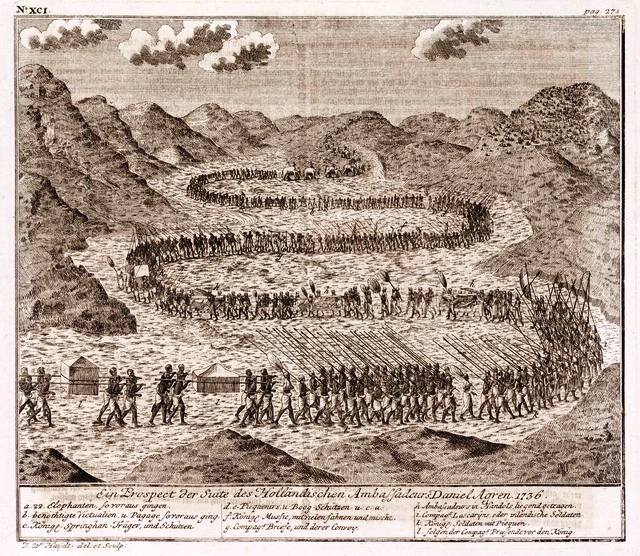
Sketch of the Dutch and their Retinue on the route to Kandy


Painting of the Dutch at the Audience with the King of Kandy


The Dutch who had made a careful study of the country’s potential for trade, in 1638, at the invitation of Rajasinghe II agreed to drive the Portuguese out of the Maritime Provinces. The Dutch were not aggressors and they were invited by the Ceylonese to liberate the country from the Portuguese aggression and forced conversions.

Replica of Dutch Galleon

They followed the Laws of the Nations by signing the Kandyan Treaty of 1638 with Rajasinghe II (1635-1687), the Kandyan King of the Hill Country and soon embarked on a war against their common enemy. As such the Dutch had a legal right to be on the island as a protector of the country.

They first occupied Batticaloa and in 1639 captured the harbour city of Trincomalee and the Fort that Rajasinghe II had offered the French as a balance of power against the Dutch. In 1640 the Dutch liberated Negombo and Galle with the help of the Sinhalese army and the Dutch Navy. In reality these forts were in marginal areas were the Kotte Kingdom had no influence. It was Tamils who lived around these forts, except in the case of the Galle Fort.

As such forts became the property of the Dutch East India Company, King Rajasinghe II wanted to demolish all of them. But the Dutch were not paid their dues against the war with the Portuguese and as a result the Dutch did not want to demolish them. The Treaty of 1638 had conditions where the Sinhalese King had to maintain and support the Dutch forces as they were waging war on behalf of the King against the Portuguese.

Canal around Dutch Fort Jaffna

The Treaty had two copies and the Dutch copy had a clause for the Dutch to own and operate the seaports. The Kandyan copy did not have this clause. The King was not abiding by the treaty as his copy was interpreted as the ports would come back to the King of Kandy and he was fulfilling his part of the obligation.

The Dutch took all the ports and forts and the rest of the lands and replaced the Portuguese. As such the Dutch never left Ceylon and started ruling the parts where they seized power as the agents of the King. The people in these areas were Tamils and they accepted their new ruler without much reservation. Only in Galle and Negombo the chance of a Portuguese attack remained a real threat.


Sketch of Dutch assault on the walls of the Portuguese occupied Galle Fort 


King Rajasinghe II always wanted to rid Ceylon of both Portuguese and the Dutch by setting one against the other. At times when Dutch officers or Commanders offended him he ordered their assassination. At times he massacred a ship load of Dutch for minor misbehavior of their Captain. This kind of cruel, crafty and unpredictable behavior made the Dutch determined to keep the forts and vast amount of lands they captured.


Negombo Fort


The King and his courtiers were paranoid and did not offer the help they should have offered an ally. As such, most of the battles were waged by the Dutch and the Dutch suffered heavy losses, but when it came to sharing the loot from the captured forts like Galle, the Kandyan King and his forces were there for the occasion and the Dutch gave half the war assets to the Kandyan King.

The Dutch carried out their war and utterly destroyed the power of the Portuguese by capturing Colombo in 1656 and finally the Tamil Kingdom and Jaffna in 1658.

The war with Portugal was against their ruler the King of Spain. Once Portugal obtained its freedom from Spain, the Netherlands settled for peace with Portugal. They then divided the occupied areas of Ceylon amicably under a treaty signed in the Portuguese enclave of Goa in India.


Transport on a Dutch Canal at Negombo


They pursued a far more progressive policy than their predecessors in the administration of the country, but through the Dutch East India Company, adopted a selfish and oppressive approach to commerce and trade. Rajasinghe II and the Dutch were both playing a double game trying to outwit each other. They never implemented the Treaty of 1638. Dutch ruled all the Tamil provinces and brought Tanjore Tamil slaves from their Indian colonies to work Cinnamon gardens in the Western Province.

Like the Portuguese before them, they attempted to unify the entire country, but failed and they too were confined to the coastal areas. Unlike the Portuguese, they enjoyed a reputation of having contributed to the economic development of the country.

The Dutch colonists established a lucrative trade with Holland, India, Persia and the East Indies. They encouraged the cultivation of cinnamon, which became their staple export. Stringent laws were passed to safeguard the industry; the peeling of cinnamon, the selling or exporting of a single stick save by the appointed officers, or willful injury to a cinnamon plant were made a crime punishable by death.


Under the Dutch agriculture was encouraged, but only for their own benefit. A system of forced labour was used to cultivate vast tracts of coconut along the sea coast and they were responsible for the unbroken groves of coconut plantations along the Western shore line.

Stripping Cinnamon

They did much to improve the pearl-oyster fisheries in the Gulf of Mannar and were the first to augment internal communication through a network of canals, which helped them establish trade connections with the interior. The longest canal that they constructed connects the Negombo Lagoon from the Kelani River up to Puttalam, the 72km long canal was constructed to transport coconut products to the Colombo Harbour. They maintained strong garrisons to protect their trading interests and to guard against hostility from the Kandyans.

The Dutch brought cultural and linguistic freedom for the people who were not with the Portuguese rulers. The backbone of Portuguese power lay with the fishermen that they had converted to their religion. The Dutch were the first to trial a republic in Europe long before France and their attitude was more democratic than any other European country. They tolerated the King of Kandy who carried out brutal assassinations against their Commanders whenever he felt offended or suspected disrespect.


Cinnamon Sorters


The Dutch tolerated one of the worst enemies they fought in battle – the Portuguese. Thus they were able to capture Ceylon without any resistance from the natives.

The Dutch started ruling and expanding their areas and the King of Kandy searched for another European power to do his dirty work and for this he approached France, but he had no success and he died in 1687. After their conquest, the Dutch also attempted to found a colony of Dutch citizens, dubbed “Burgher”. This was attempted first under Maetsuyker (Governor from 1646 to 1650), but at the end of his government and later under Van Goens (Governor from 1662 to 1663 and 1665 to 1675), there were only 68 married free-burghers on the island. Such a policy was clearly a failure as only a few Dutch families settled on the island. In the first 30 years of Dutch rule in Ceylon, the Burgher community never exceeded 500 in number and was mainly composed of sailors, clerks, tavern-keepers and discharged soldiers.


Peeling Cinnamon


The Dutch East India Company (VOC) to support this emigration facilitated in any case, the Burgher. Burghers alone had the privilege to keep shops, were given liberal grants of land with the right of free trade. Whenever possible they were preferred to natives for appointment to office. Only Burghers had the right to baking bread and shoe making. Most of them were employees of the Company.

The marriage between a Burgher and a native or an Indo-Portuguese woman was permitted only if she professed the Christian religion. However, the daughters of this union had to be married to a Dutchman, as Van Goens said: “…. so that our race may degenerate as little as possible”. In the eighteenth century a growing European community comprised of a mixture of Portuguese, Dutch, Sinhalese and Tamil had developed in Ceylon.


Baling Cinnamon

They dressed European, were adherents to the Dutch Reformed Church and spoke Dutch or Portuguese. With passing of time, the Burgher community developed into two different communities – Dutch Burghers and Portuguese Burghers.

The Dutch Burghers were those who could demonstrate European ancestry (Dutch or Portuguese) through the male line, were white, Dutch Reformed and spoke Dutch.


The Portuguese Burghers (later called Mechanics) were those who had supposed European ancestry, had darker skin, were Catholic and spoke Creole Portuguese.

The European community produced all the priests (Predikants) of the Dutch Reformed Church.

During the Dutch period, the growth of the community was constant. A small, but steady influx of newcomers from Europe mixed with the families, which had settled on the island for generations. Thanks to this, the Burgher community was able to retain its open character and the heterogeneous cultural traditions.

In the last decade of Dutch rule in the island, the Burghers formed a detachment of citizen soldiers. They defended the ramparts of Colombo during the Anglo-Dutch war.

Dutch Reformed Church – Colpetty

The regular Dutch army at that time was made up of Malay/Javanese soldiers led by the Princely class of Malay/Javanese families who were exiled to the island by the Dutch in Java. A host of royal families from the Dutch East Indies spent their time in Ceylon as political exiles. The other place of exile was Cape Town in South Africa, where a Malay community emerged in later years.

I recommend a visit to this web site about Malays in the current Sri Lanka Army.

http://www.youngmelayu.com/2013/12/the-arrivals-of-malays-in-sri-lanka.html

Below is an interesting presentation on the Muslim people of Sri Lanka.


The Dutch also had another European force named the Swiss deMeuron Regiment under their command that was stationed in Trincomalee. In 1781, the French Authorities helped raise a new regiment in the Swiss Canton, soliciting recruits in and around Neuchatel. The regiment was called the deMeuron Regiment, taking its name from the commander, Comte Charles de Meuron. In 1786 the deMeuron Regiment was sent to Ceylon from Cape Town and while in Ceylon the regiment answered to the Dutch Governor Van Anglebeek and to Colonel Pierre de Meuron, the brother of Comte Charles de Meuron who had returned to Switzerland.

At the time of the British conquest in 1796 there were about 900 families of Dutch Burghers residing in Ceylon, concentrated in Colombo, Galle, Matara and Jaffna.

After the British took over the colony from the Dutch, some Dutch Burghers chose to go to Batavia, while others chose to stay in Ceylon. 

Many of the paternal ancestors of the Rowlands Family, namely the "Arndt's and others remained in Ceylon and worked for the British. 

Just prior to the takeover of the island by the British an ancestor of the Arndt branch of the Rowlands family (Thomas Nagel) was given the task of organizing the administration of an area in the North of the country known as the “Vaani”. The article about his administration and the Dutch period is reproduced below.

The Dutch in Ceylon.

The focus had been on the administration adjustments made by the governor to improve the agriculture and revenue in the core areas, Colombo, Galle and Jaffna. The emphasis in these regions lay on the production of cash crops, with cinnamon being the first and foremost.

However the demand for rice to feed the troops and the coolies remained a pressing subject and paddy cultivation was high on Van de Graaff ’s agenda. The rice was meant not only for the garrison, but also for the cinnamon department and coolies in general: the more work to be done, the more rice was needed. Around four thousand lasten of rice a year were needed to sustain the labour force, but the Dutch could not even get half of that from their possessions on the island. In 1784/85, the Dutch
regions of Ceylon yielded 1,798 lasten of rice for government, the year after it was about 1,500 lasten and most of it came from Matara and Jaffna. For example, Batticaloa did not produce more than eighty-seven lasten for the Company. Batavia could not furnish Ceylon with as much rice as it had, but still yearly requests were made to Batavia for supplies of at least eight hundred lasten of rice, and the expensive contracts with the South Indian traders accounted for the rest.

The high expenses involved in the acquisition of rice convinced Van de Graaff that the island should really become self-sufficient in its food crop production. This idea had been proposed earlier by Van Goens and Van Imhoff, but it was Van de Graaff who made a concerted effort in this direction. With the cinnamon plantations blooming in the southwest, he moved his attention to the peripheral Dutch possessions on the island. It was his intention to turn these regions into a broodkamer or breadbasket,
for the rest of the island. The areas to the east of Matara, which had become Dutch after 1766, and to the interior of Batticaloa, were now actively reclaimed. The same was true of the Vanni district where the local chiefs, the vanniyars, who had governed their lands in relative independence, were removed and the Dutch Lieutenant Thomas Nagel took up the task of improving agriculture.

Here and there, in the Magampattu bordering Matara dessavony and the Panoa in Batticaloa, Van de Graaff even extended Dutch authority into Kandyan lands. The measures taken by Van de Graaff varied greatly. For example he made the headmen promote the technique of transplanting paddy instead of seeding, because in this way the plants yielded more grain and less was wasted for the seeds. Another plan of Van de Graaff related to the planting of manioc or cassava. He thought that if inhabitants grew manioc for their basic food consumption, this would not only prevent famines, but
they would also consume less paddy allowing them to sell the surplus to the Company. He enthusiastically sent the manioc plants around to all stations, with instructions on how to grow it, but the inhabitants were not easily converted to this new foodstuff and the plan was a failure. He also
intended to colonize the sparsely inhabited regions of the island with migrants from South India, Indonesia, or China. With the exception of a group of sipahis settling in the Panoa, these operations did not succeed either.

Other plans regarded irrigation and waterworks on the island. Great expectations were set on the Giant’s tank close to Mannar. However financing its repair was difficult to arrange because Batavia refused to invest in such a large and expensive project. Van de Graaff hoped that he could get around this with private investment, but did not succeed in raising enough money. Similar plans were made for the Kantelai tank near Trincomalee, but never put into effect despite all the preliminary work
put into the investigations by the engineers and the officials of Mannar and Trincomalee. We have already seen that in the Matara dessavony some undertakings were started with great zeal by the dessava Christiaan van Angelbeek. There the problem was not so much the preservation of
water, but rather the drainage of surplus water that caused flooding in the rainy season. Several canals were dug for this purpose in the Gangebaddepattu and the Magampattu, but not all were finished by the arrival of the British. Moreover the work in Matara was hampered by the rebellion of 1790, which made Van de Graaff and his successor more prudent in undertaking these large projects.

The rebellion in Matara has been discussed briefly in the context of the private power struggles among Company officials. It was pointed out that the headmen played a role in this as well; those who were losing out on the new projects were especially against it. But from the first reports about
the rebellion it is clear that the inhabitants themselves objected to working on the canal as coolies (as they had done in the previous years) because they expected a good crop and did not want to spend their time working for the Company or the headmen. They were afraid to be pressed into
their work by the headmen on the order of the dessava Christiaan van Angelbeek. Although the work on the canal was heavy and they were most likely not well-treated, they had not rebelled against it previously, and it is probable that in times of bad harvest work on the canal at least provided them with basic provisions of rice and a little money that enabled them to feed their families. What is of interest here is that in good times the inhabitants could not see any advantage in working on the canal even though it could in the end also be of advantage to them, because it aimed to prevent floods in the
rainy season. The rebellion in Matara is an example of how colonial intervention led to a clash of mentality between the Dutch and the native population that was not easily overcome. This was even more the case in regions where contact between the natives and the Company had been rare, like in the Vanni, Trincomalee, and Batticaloa. These new encounters and colonial interventions in the periphery, through an analysis of the reports and memoranda written by Jacques Fabrice van Senden, Thomas Nagel, and Jacob Burnand on their operations in these districts.

New encounters in the periphery: a journey around Trincomalee.

The “discovery” of the periphery led to new encounters between the native population and the Dutch officials. These did not always go smoothly and it was not an easy task to implement the same energetic policies in these regions as had been done in the core. The diary of the exploratory journey that Van Senden, head of Trincomalee, undertook in the spring of 1786, gives insight into this interaction and how both the Dutch and the natives experienced this new encounter.251 It also reveals
the utilitarian attitude of the Dutch regarding the nature and people of Ceylon, and it went hand in hand with the discovery of the island’s rich past in this northeastern dry zone. Moreover it very clearly reveals the clash of interests between the natives and the Dutch and their different
perceptions of their environment.

Van Senden’s journal consists of four parts. The first part, about his journey through Kottiyar, is the most extensive. This is followed by an account of the possible measures to be taken to improve the agriculture there. The third and fourth part, about Tamblegam and Kattukolom, are much shorter. In those sections, Van Senden refers often to earlier remarks he made about Kottiyar, which was connected to Kattukolom by the bay of Trincomalee; Tamblegam was located more inland, and bordered the territories of the Kingdom of Kandy. The land on the coast is by and large flat, but in the interior the landscape is more diverse with plains and hilly areas. Salt production on the coast of Kattukolom formed an important industry for the region. The salt was mainly purchased by
traders from Kandy and by the VOC in Trincomalee. The hinterland of  Trincomalee was densely populated and had an impressive past. Van Senden describes with great interest the remains of temples, bridges and irrigation works of the ancient kingdoms that he saw on his travels. The
most impressive ruin of all was that of the water tank of Kantelai in Tamblegam.

Van Senden travelled by boat, horse and palanquin and had himself accompanied by the most prominent native headmen of the area. In Kottiyar he was assisted by the vanniyar Irroemarooewentoega Ideewirasinga Nallemapane, in Tamblegam by the mudaliyar Don Fransisco
Kannegerandge Kannegeritna and in Kattukolompattu by the vanniyar Don Joan Sandere Seegere Mapane Wangenaar. The local population took care of provisioning the group. The first thing Van Senden did when arriving in the villages was to make up a register of all male inhabitants. The villages on the coast numbered up to a hundred men, but the other settlements were much smaller, with only seven or eight adult men. In some places, in particular in Tamblegam and Kattukolom, it was impossible to count the inhabitants, because they fled.

Van Senden’s visit to Moedoer, the first village he called at, may serve as an example of his encounters. The village was relatively large, with one hundred fourteen adult males, and was located on the coast at the mouth of the river Kinge. The first thing Van Senden noticed was that
there was a lot of waste land. The paddy fields that were in use looked fine, but the water tank that had to supply the land in the dry season was not well placed. It lay too low and as a consequence the water could not reach the fields. He therefore showed the people how they could water the fields using dam and pipe-constructions, so they could also exploit the waste lands. He inspected the river and wondered whether a water mill could be placed there to saw timber. Next he checked whether the river could be diked to prevent floods in the wet season. He explained the inhabitant that the higher grounds, which were not used at all, were perfectly suited to growing fruit bearing trees. He thought of plantations of between three thousand and twenty-two thousand coconut palms. Van Senden did not understand why the inhabitants did not put effort into producing more; they could barter the surplus and the population would increase and this in turn would lead to higher production.

The un-sown paddy fields, water regulation and the poor fruit tree plantations are subjects that recur again and again in the text. Many times Van Senden pointed this out to the vanniyar who travelled with him, and encouraged him “to make better use of that which nature had given him and his people so generously”. He saw everything in terms of exploitation: the rivers were waterways or energy providers, the land was meant to be used as paddy field or plantation, and the river clay waited to be used for the production of bricks and tiles. Wild buffalo were suitable draught animals for tilling the soil, wild elephants could be caught and traded with India. Van Senden even tried to transmit his own technological knowledge to the inhabitants, in the case of the dam-and-pipe construction in Moedoer.

Van Senden’s utilitarian attitude towards nature emerges frequently, and he is almost as often disappointed with the state of the agriculture and the commitment of the inhabitants. Sometimes he was pleasantly surprised though, for example when he visited the village Pattianoette, with only thirteen inhabitants, on Saturday 10 June: “There is a little pagoda here which has nothing special, except for the brahmin priest, who loves planting and has planted part of the empty space that usually
adjoins the pagodas, with lime trees and other fruit-bearing trees.” Van Senden liked this so much, that he promised the man seeds and pits of other fruit trees to extend his orchard.

Van Senden did not pay attention only to agriculture. He was also interested in the roads and rivers. Here he was confronted with the limitations that nature forced upon people and he complained much about it. Because of the heat, he could only travel early in the morning or late in the afternoon, and sometimes he even travelled at night. The rivers turned out to be un-navigable because the riverbeds had run dry, or had grown thick with mangrove forest. Paths to specific destinations often turned out
to be impassable and “made for no one but forest people”. Elephants occasionally formed an obstacle when he travelled through Tamblegam: in large numbers they obstructed the road and terrified his retinue. The elephants could only be scared away by gun shots. Above all this, van Senden was feeling ill during his whole journey. He could sometimes barely feel his fingers and sometimes his nerves troubled him so much that could not continue the journey. In Kottiyar and Tamblegam in particular he suffered much from mosquitoes at night.

Despite everything, Van Senden often expressed his admiration for the natural environment. On the plain close to the village of Kooijkoederipie settlements were built on small hills and the plain was used for paddy culture: all these islands or raisings are covered with coconut palms like feathers and
the pattern of light green of the fields that have not been reaped yet, and the hayish-yellow of those that have already completed the reaping, and the dark green of the trees, shows us one of those spectacles which convinces us, like with everything, of the supremacy of nature above art.

It is typical of Van Senden’s attitude that he uses the word nature when he is talking not about a wild jungle, but about a landscape that has been.

Clash of cultures: useful versus threatening nature

The interesting thing about the travel journal is that Van Senden wrote down not only his own observations, but also the inhabitants’s responses to his suggestions. When Van Senden proposed in the village of Moedoer that everyone should produce more than they needed for themselves, he
was told that “Through the outbreak of diarrhea and children’s diseases for some years now, the country had become depopulated [...] and each of the few remaining people do not cultivate more than what they need in one year.” From the villagers’ answers to his suggestions, it becomes clear that their existence was very insecure because of certain natural factors. Therefore they could not see the point of expanding agricultural output. The region was plagued by wild animals, and hordes of wild elephants in particular who damaged the fields and panthers and bears who prowled about the district. The climate often worked against them: in the rainy season floods could ruin the crop, but long periods of drought also had damaging effects. Finally, in the previous period many people had
died from disease. Remarkably enough, Van Senden did not recognize this problem; apparently the people must have looked healthy at the moment he travelled there.

Apart from all this, Van Senden met a lot of distrust from the inhabitants with regard to himself as a white representative of the Dutch government. Sometimes the inhabitants fled when they were informed of his approach. They feared be taken as slaves, or being eaten by his Malay soldiers.
Van Senden thought this nonsense and tried to convince them of his good intentions by explaining the purpose of his trip and by offering useful instruction, giving them extra sowing seed and promising them postponement of taxes. Still, it did not always work, as the example of his meeting with the men of Elendetorre shows. There, Van Senden explained how fruit-bearing trees were best planted. He subsequently asked the inhabitants whether they would start planting trees straight away, if he would provide them with seeds or offshoot: After murmuring for some time, an ancient man, who could not have much hope of enjoying those fruits, came forward, and said with a smiling face: “why would we go into all this trouble, our grandfathers and fathers never did it.” This was agreed upon by all the attendants.

According to Van Senden this inertia was the inhabitants’ most evil quality and had to change.

Van Senden portrayed the native inhabitants not only as inert, but also as simple and angst-ridden. These characteristics came to the fore most strongly in the folk tales he collected. Van Senden was mainly interested in stories related to the prominent ruins he encountered. In Tamblegam for example he passed a river with a few standing pillars in the middle. The local people believed that these had been placed there by a mythical washerwoman. This woman appears again and again in the local accounts explaining the origin of the large ruins. Van Senden concluded however that the pillars would have been part of a bridge, of which the upper part was gone.

Although Van Senden was sometimes a little scornful of the folk stories, his interest in them was sincere. Most attention was paid to the stories that related to the ancient water tank of Kantelai. The people turned out very fearful for the water tank. […] in the morning at four forty I left Kooij Koederieppoe for the infamous, and never mentioned without fright by the Mallabars, Kantelai tank. They tried everything to prevent me from going; warnings, admonitions and the worst: citing the many examples, which I knew were true, of curious people, who died shortly after the visit or never recovered from lingering diseases, but nothing helped; the usefulness of the Kantalai tank, for the agriculture of the province Tamblegammo was too important for me not to see it with my own eyes–for the notorious devil Poedem, who had made the facing of the tank in six days as servant of the King Kollekooten and still guards it, I had no fear, but I dreaded the poultice and cooked mess of the superstitious […].

In deference to the strong aversion of the people, he decided to ask the “heathen priest” for permission beforehand. He explained to the inhabitants that he took their warnings seriously, but that he wished to behold himself the structure “that I thought was made by humans, though they attributed it to spirits”. He would however behave respectfully and hoped that the inhabitants would join him in seeing it.

Despite all warnings Van Senden visited the tank and was clearly much impressed by the enormous construction. Moreover, he showed his companions that the irrigation tank could be made ready for use through a few minor operations like taking away the mud in the pipes. He ordered the headmen who had joined him that in future the tank had to be cleaned in the dry season by all the inhabitants together. Those who did not cooperate would not be allowed to make use of the water for the irrigation of their fields.

The section on the Kantelai tank is essential to understanding the differences in outlook between Van Senden and the inhabitants. Van Senden depicts himself as the all-knowing, rational European, in sharp contrast with the primitive and superstitious indigenous population. The fact that the inhabitants attributed a structure like the water tank of Kantelai to devils revealed their fearful and primitive nature and their incapacity to control nature and adapt it to their needs. The remains of temples, bridges and, water tanks did however point at a higher civilization and more intensive use of the land in the past, and a higher population density. This rich past appealed to Van Senden’s imagination and strengthened his belief that the region could turn prosperous once more. It is no
coincidence that in his scheme for improvement, he laid great emphasis on the ancient civilization of the inhabitants.

Civilization as universal remedy

Apart from the suggestions for improvement of agriculture made on the spot, Van Senden also formulated a more general plan for the exploitation of the land. He was of the opinion that three factors could contribute to its improvement. In the first place, the region had to become more densely
populated again. He thought that under certain conditions the Company might attract South Indians, Malay soldiers after they resigned service or even Chinese to settle in the region. But basically, he was of the opinion that the inhabitants had to produce more children, for this would give them more economic security.

This point relates to the second and third factors. Van Senden felt on the one hand that people had to make an effort to become more active and enterprising. On the other hand he believed that the Company had to invest in tools and seeds for every village and that the Company should not raise taxes for a few years in order to give the people a chance to substantially increase the agricultural output. Finally he thought it would be best if every province had a European superintendent. This was impossible to arrange from one day to the other, not only because the Company did not have the funds for it, but also because of the people’s fear of white men. Moreover in the case of Kattukolom, the inhabitants were strongly attached to their own headmen and would probably not accept the
authority of a European resident. Van Senden realized that the Company would not be prepared to invest on a large scale and that the chances of successful colonization by outsiders was small.

Therefore, Van Senden expected most from the change in the attitude of the people and his text is full of references to this. It was not for nothing that he cited with pleasure the story of the washerman who gave his life when attempting to remedy the blockage of the Tamblegammo tank by a large fish. “For the honour of mankind I wish to record this case as true, to have it carved on a stone in various languages and to write underneath in Golden letters: What a man! what a father! but most of all
what a fellow citizen!” Van Senden considered this story an elevating example for the inhabitants.

This elaboration on Van Senden’s journey reveals many of the practical issues at stake in the late eighteenth century Sri Lanka. It shows Europeans’ growing self-confidence in relation to the management of nature, the sense that all natural obstacles could be overcome by human knowl-
edge and power. It also reveals an obsession with the island’s ancient and rich past that strengthened his conviction that the region could and had to be more intensely cultivated. Van Senden strongly contrasted himself with the native population, who are clearly in need of European guidance
to improve their lives and that of their children. The natives’ fear of Europeans shows how little the Dutch had intruded into this region so far, although their fear could also be explained by their recent experience with French and the English troops behaving ruthlessly while they occupied the harbour of Trincomalee between 1782 and 1784.

Van Senden was not very sensitive to the actual problems of the inhabitants, in particular the diseases which afflicted them repeatedly. We now know that it was a malaria-prone area, and the debilitating influence of structural malaria on a population is a well known fact. Van Senden did not notice it because he did not know about it, he could not connect the stories about the devil poedem with the anopheles mosquito that probably bred in the tanks. His energetic and progressive attitude is typical of the period of Van de Graaff ’s governorship, and not surprisingly Van Senden was strongly attached to Van de Graaff. The outcomes of Van Senden’s schemes for improvement were limited. Residents were appointed on his advice and the income from the paddy tithe increased fivefold, which points at significant improvements. But although the engineer Fornbauer made a precise plan for its repair in 1792, the Kantelai tank was never fully repaired. Van Senden died within three years after the journey.

Colonial intervention in the Vanni

In his own memoir Van de Graaff dealt in great length with the progress of the paddy cultivation in all regions of the island. He stated that much progress had been made in this field in the previous years, with the exception of the Colombo dessavony where most workers were involved in cinnamon
culture and could therefore not be involved in the improvement of the paddy culture. However, a lot had been achieved in other regions, notably, the outer parts of Matara, Batticaloa, the Vanni, and even a little in Trincomalee.

The achievements are difficult to assess, but if we are to believe Van de Graaff they were great and promising. We have seen already that Van Senden’s plans for Trincomalee resulted in some expansion of agricultural output. The most structural approach had been in Batticaloa and the Vanni, where administrative reforms were more extensive and intensely supervised by two enterprising officials. In Batticaloa it was Jacob Burnand, a young man from Switzerland who had arrived on the island in 1778, and in the Vanni it was Lieutenant Thomas Nagel. Both brought into cultivation. fully improved the agricultural situation in these neglected districts and their reputations lasted into British times. As we shall see, Governor Maitland used their work as example for his own policies in those regions and beyond. Therefore, their work merits a more extensive discussion. The Vanni district covered the large area between the Jaffna peninsula and the Kingdom of Kandy and was largely inhabited by people of Tamil origin. Before the late eighteenth century, the administration of the Vanni had been the most obvious example of the VOC’s system of indirect rule.271 The vanniyars, or local chiefs, were in theory subordinated to the Company and under the commandment of Jaffna. They had to pay a yearly tribute of forty elephants to the Company, but the Company did not otherwise meddle in their administration and they maintained a fair degree of autonomy. In the course of the eighteenth century their obligations became diluted and during the 1770s the Jaffna commander was complaining repeatedly that the vanniyars were in arrears on the payment of their tribute. By 1780, troubles in the district caused by a succession struggle in one of the provinces of the Vanni allowed the colonial administration to step in.

The Company considered taking over the whole district, but due to the scale of the operation Governor Willem Iman Falck decided that only the province Karnawelpattu should be brought under direct Dutch rule. It was an experiment, and the aim was to learn how much profit this province would bring the Company. Falck had reason to have high expectations, since it was common knowledge that in ancient times the district had produced high yields. The resident, Mr Sprang, was requested to do everything in his power to improve agriculture. By 1784, the vanniyars in the other provinces started to rebel against the Dutch, which gave Governor Falck a reason to organize a punitive expedition. Under command of the Lieutenant Thomas Nagel, the provinces were conquered one by one. Nagel was appointed as head of the district and commissioned to improve the cultivation of paddy and increase the revenues of the district.

In 1789, Nagel requested that the colonial government lease him the district for five years. Under his proposal he would personally make the necessary expenses to improve the local situation, provided he would be allowed to keep all revenue from it, except for the paddy-tithe. The military expenses would still be paid by government. His request was honoured.

In 1794, Nagel requested an extension of the lease and wrote a memorandum to explain the successes achieved so far and his plans for the future. The memorandum is divided in nine paragraphs. The first four give an introduction to the district, its nature, its people and its history. Paragraphs five and six are concerned with the history of the Company’s presence in the district. Nagel describes how and why it was occupied and what improvements were made especially in the field of agriculture. In the
following two sections Nagel elaborates on the strategic importance of the Vanni and gives a description of his plans for further improvement of agriculture. The final paragraph discusses his new proposal for the next ten years. Nagel’s achievements in the district were considerable: he improved the income of paddy, collected as the Company’s tithe, from 14,000 parrahs of paddy to 36,000 parrahs.275 In addition, the income from taxes on gardens and trade increased. What measures did he take to achieve this?

Thomas Nagel started with an administrative reorganization based on the Dutch administrative system in Jaffna. In the aftermath of his expeditions, he had put aside the vanniyars, and in the new government they were left out. The civil administration consisted of ten, later twelve, Europeans or men of European descent and eighty natives, of whom sixty were lascorins. Next to that he adopted a headmen system: eighteen mudaliyars were put in charge of the provincial government and thirty-six majorals were to work under them. The new land-courts were to apply the Jaffanese laws to the Vanni. Even the organization of the taxes and land revenues were copied from the Jaffna system. He ordered a hoofdtombo (family register, for the purpose of taxation) to be made and decided that like in Jaffna the people would be obliged to work twelve days a year for the Company (or to pay one rixdollar and four stivers for each day they did not work). The land tax was fixed at a tenth of the crop, to be paid either in kind or in money.

The increase in agricultural output was achieved by three measures. First, after the bad harvests of 1787 and 1788 caused by a lack of rain Nagel lent seed to the peasants on his own account, to ensure a reasonable crop the following year. Second, he started a land registry, identifying the wasteland suitable for exploitation and reporting on the condition of the water-tanks belonging to the occupied fields. Because many of the tanks were in a bad state, he made a plan to repair them and figured that
in total about twenty-five thousand rixdollars were needed to fix them all. Nagel shouldered the burden of these investments himself as part of the contract he made with Governor Van de Graaff in 1789. In the same year he employed four natives in the function of adig¯ar with the specific task
of overseeing the agriculture and the repair of the tanks. By 1793, much progress had been made, but more time was needed to meet the objectives. He planned to set up sugar, coffee and cotton plantations by forcing the poor inhabitants from the overcrowded Jaffna district to move to the Vanni and work on his plantations. He also intended to make the people of the Vanni cultivate these cash crops for the Company with one part of their fields. These plans were inspired by Anthony Blom’s 1787 treatise on sugar, cotton, coffee and cacao plantations in Surinam.279 Nagel regretted the fact that it was too complicated to keep African slaves on the island to set up a plantation on Blom’s model, but he considered his own plan a good alternative.

Nagel’s rule over of the Vanni was quite different from that of the vanniyars. The changes directly touched the interest of the people owing to the imposition of new taxes, the regulation of personal services and the fixing of land revenues. It was turned from a system of indirect rule based on feudal relations and only limited Company power to a relatively well organized state under European authority and a European administrative elite. The new organization was geared to agricultural development rather than to trade. The vanniyars saw their power curtailed by Nagel and no longer played an official role in the inland administration. It is not clear whether or not they kept some power over the inhabitants based on their former position and traditional status.

Administrative reform in Batticaloa

The eight provinces of Batticaloa were governed by a chief of the rank of onderkoopman, from 1766 onwards. Jacob Burnand was the second person to hold this post, after his predecessor Francke had held it for eighteen years. Burnand was of Swiss origin and had arrived in Batavia in 1775 in the position of onderkoopman, and moved to Ceylon in 1778. It had been his intention to return to Europe in 1794 as a man in bonis after nineteen years of service in the East, but due to circumstances he had been forced to stay on the island and he remained there even after the British take-over. Burnand wrote his memorandum for reasons that differed considerably from those of Nagel. He wanted to provide his successor Johannes Phillipus Wambeek with all the information necessary for
the administration of the district and, in his own words, “particularly [with] the plan which I am of the opinion should be constantly followed in order to answer the well-grounded expectation of making further improvements”. Like Nagel, Burnand had come to the district with the governor’s commission to improve the agriculture and increase the income of paddy. In this he succeeded, by enlarging the income from the tenth on paddy fivefold, from 17,010 parrahs to almost 60,000 parrahs. He even predicted that if policies were continued along the same lines, in future it would be possible to obtain one last or 84,000 parrahs of paddy. The measures he took to achieve this were as follows. When Burnand arrived in Batticaloa he ruled over about forty thousand people and had twelve European civil servants at his command. For the administration of the district the chief had to rely heavily on the co-operation of the native headmen, called hoofd-pedies. These men collected
the paddy tithe for the Company and functioned as justices in the rural assembly. They all came from a group of about five hundred families who held half the fields in the district and who had also served as headmen under Kandyan rule. These families were called Mukuvassen.

Soon after his arrival Burnand perceived two major defects in the administration of the district. The first was in the organization of the collection of the tithe: the headmen tended to keep the larger part of the tenth for themselves. The second deficiency lay in the organization of the oeliam-services (corvée labour), which put the burden on the field labourers, the group of people who in his opinion were the crucial factor in achieving any improvement in agriculture. Due to their connection to the
land, they were easy victims for the headmen who had to organize the oeliam-services. By forcing them to perform the Company’s heavy cooliework like dragging timber, they got worn out and were taken away from their daily task of working on the land. As a result they spent less time on the fields and produced only a small harvest. Other people, who were supposed to perform services bribed their headmen or hid from them. Just like Van de Graaff, Burnand aimed to rationalize the taxes and
services, and to increase control over the headmen. To achieve this, he developed a consistent bureaucracy. He did not abolish the corvée duties of the field labourers, but he decided that they were not to be used anymore to perform heavy labour for the Company. Instead their services would consist only of activities that would improve agricultural conditions such as repairing tanks and dams vital for the irrigation of their fields. At the same time, the people who were not involved in agriculture were registered carefully and their traditional duties were fixed. Burnand categorized society in eighteen castes, or occupational groups. He registered all groups and his memorandum discusses the functions of each in society, their size, their place of abode and the taxes and services
that each owed to the Company.

At first he had organized the paddy collection in a manner similar to the way Van de Graaff had done it in the southwest. The headmen were kept responsible for the organization and supervision of agriculture, and the paddy taxes were farmed out to the highest bidder. By 1789 Burnand came to the conclusion that he could not rely on the headmen at all, despite his efforts to strengthen his control over them: All pains taken to make use of these headmen in carrying the present regulations into effect [have] proved fruitless either by their negligence or reluctance to take the trouble upon them or because they saw no chance to enrich themselves with the revenue of Government […].

Therefore he decided to overlook the headmen and organized a native administration, composed of canicopolies, native accountants, and canga-nies, overseers. Their tasks were clearly defined and they received a fixed salary. He described in detail how these native servants should function, how they had to make use of “annotation olas” (palm leaves) to report on the crop and its collection, and how often they should make these reports and send them to the secretary’s office. His attitude towards these civil servants was rigid. He stressed that they only worked properly if the authority of the chief was firmly established by punishing them heavily from the outset for every little attempt at fraud. Here he deviated from the policies of Van de Graaff for the southwest, but resembled more the
administration of Nagel in the Vanni.

By installing this twofold administration, Burnand aimed at marginalizing the headmen and rendering the Company independent of them. Despite some temporary opposition from the headmen, this was achieved in course of time and he was able to state that the “most part of them is at present entirely unnecessary and may be dispensed with, the sole utility will be to let them act as controllers of the native servants […]”. The headmen’s income was further curtailed by the prohibition against accepting any presents from inferior chiefs or to taking fines in court. In fact, these prohibitions had been brought in to practice after the proclamations of Van de Graaff against the taking of the paresses, a step which was highly praised by Burnand in this memorandum.

Another step to limit the power of the headmen over the people was taken in the field of justice. Burnand reorganized the rural assemblies: instead of every six weeks, as under his predecessor, they were held only twice a year. Moreover, they functioned not as the main courts for all sorts of civil and criminal cases, but mainly as an agricultural board where the expected harvests and revenues were discussed. Only cases that could directly be decided upon could be brought to trial here. This was done to improve the legal security of the common people, since they were often opponents of the headmen in the court cases. In 1789 a landraad was established. Native judges were appointed directly by the Company and the headmen played no role here. The final responsibility of the verdicts
lay in the hands of the Dutch chief of Batticaloa, which gave him great authority over both the people and the headmen.

In his discussion of plans for the future, Burnand elaborated on the importance of trade for the district. He was of the opinion that free trade in local agricultural products and circulation of money would prove to be an encouragement for agriculture. He stated that in previous times, the price of grain had been kept artificially low, which kept people from producing more than what they needed themselves. He criticized the Company’s general policy of monopolizing even local trade and he praised the measures taken by Van de Graaff in 1786 to leave the paddy-trade in the district free.

Conclusion

For the first time, not only the southwest and Jaffna peninsula were subject to the processes of colonial intervention. The peripheral regions’ experience of colonial intrusion was however very different from that in the core regions. Here the main aim of the colonial rulers was to increase the production of rice, and Van de Graaff explicitly designated these areas as the storage-rooms for the rest of the island.

Although the governor increased the agricultural output, this was not entirely a success story. In Matara the native labourers rebelled against the continuous call for labour. In general, the increased exploitation seems to have weighed heavily on the backs of the peasants. The new opportunities
for some of the native chiefs caused jealousies among them and some of the Dutch officials. In the peripheral districts, the Dutch heads like Van Senden found that it was not an easy task to convince the local inhabitants to produce more than they needed for themselves. The continuous struggle for life and the natural and mystical threats that surrounded them made it useless in their eyes to expand their agricultural production. And although the administrators of the peripheral districts managed to increase the output of paddy, the clash of cultures and mentalities reveals the limited reach of colonial plans and policies, something with which the British were to deal with as well.

In the peripheral districts the native administration was dealt with very differently than in the core districts. There, the former elites were banned from their position and replaced by either Dutch or Portuguese burghers in the Vanni, or by men from the Vellalle caste in Batticaloa. Clearly they found themselves in a very different position from the powerful native headmen in the southwest. Did this relate to a weak social-economic organization in the region, the absence of Kandyan interests in these
regions, or the very specific historical collaboration between the Dutch and the headmen in the southwest? This question will be taken up in the later 

The Arndt Family Genealogy is listed at the end of this blog.